How to configure RADIUS authentication in EventLog Analyzer
Objective
Enable secure user authentication in EventLog Analyzer using an external RADIUS server.
Prerequisites
- Have a configured and reachable RADIUS server.
- Have a RADIUS shared secret key (used for verifying communication between EventLog Analyzer and the RADIUS server).
- Have valid user credentials in the RADIUS directory.
- EventLog Analyzer should be able to connect to the RADIUS server through the specified port.
Steps to follow
Step 1: Log in to EventLog Analyzer with an administrator account.
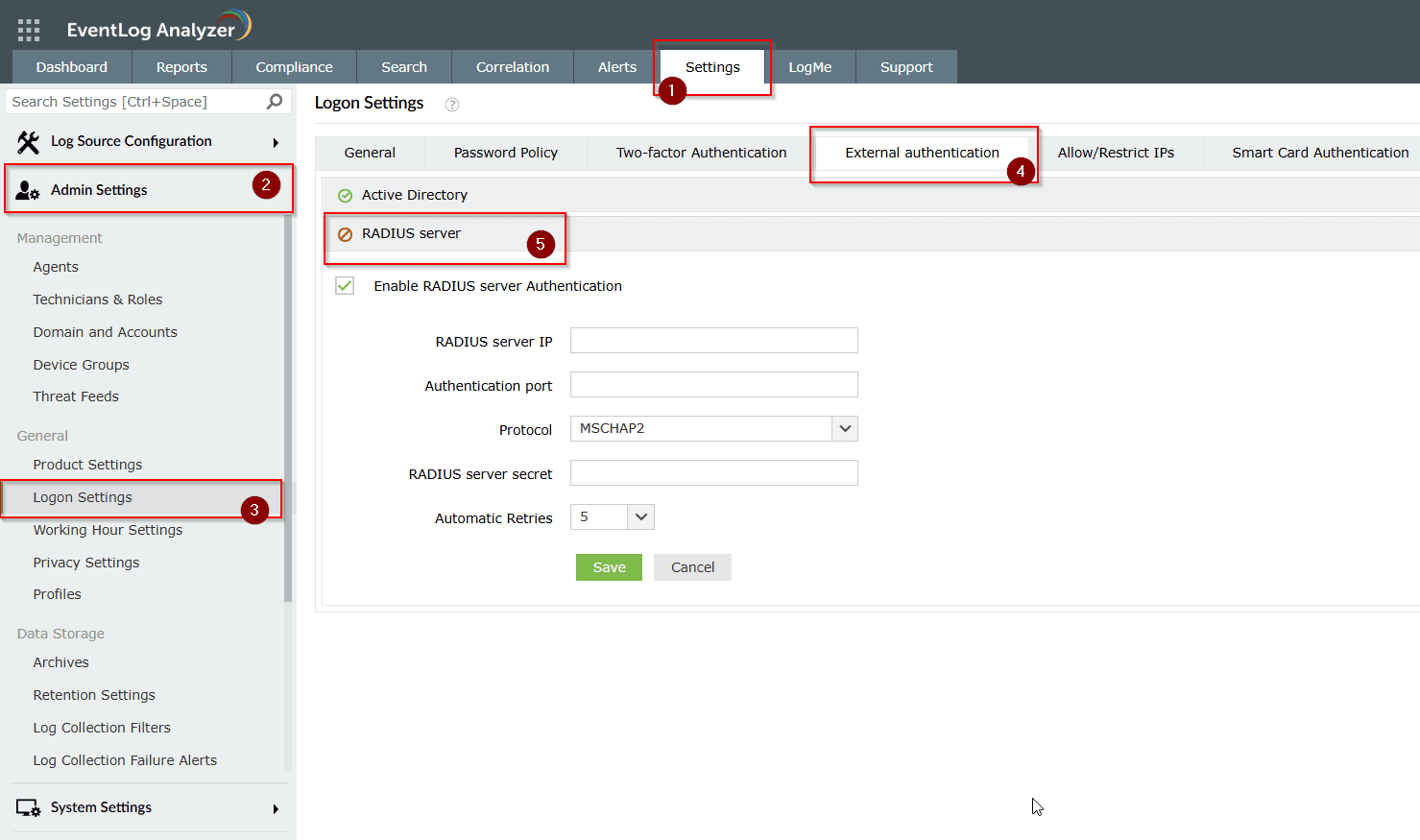
Step 2: Navigate to Settings > Admin Settings > Logon Settings.
Step 3: Click the External Authentication tab.
Step 4: Under the RADIUS Server section, check the box for Enable RADIUS Server Authentication.
Step 5: Enter the following details:
- RADIUS Server IP: Provide the IP address of your RADIUS server.
- Authentication Port: Enter the port used by your RADIUS server (the default is usually 1812).
- Protocol: Choose the desired protocol from the dropdown (e.g., MSCHAP2).
- Shared Secret Key: Enter the shared secret key used to authenticate communication with the RADIUS server.
- Automatic Retries: Select the number of retry attempts allowed in case the initial connection fails.
Step 6: Click Save to apply the settings.
Step 7: Try logging out and logging back in using a RADIUS user account to confirm the setup is working.
Tips
- Protocol selection simplified:
- PAP: Very basic method. Sends passwords as plain text. Avoid unless absolutely required and protected by encryption.
- CHAP: Adds more security by using a challenge-response process instead of sending the password directly.
- MSCHAP: Microsoft's version of CHAP. Better than CHAP but has known weaknesses.
- MSCHAP2: Latest version. Provides mutual authentication and is the most secure among these options. Recommended.
- Ensure the firewall allows communication between EventLog Analyzer and the RADIUS server on the selected port.
- Make sure the RADIUS server is running and the user credentials are active and valid.
- Always keep a local admin account active to avoid being locked out if RADIUS fails.