[Tips & Tricks] How to enable smart card authentication in ADSelfService Plus?
How about a hassle-free, passwordless, yet secure login to ADSelfService Plus?
If your organisation already utilises smart cards/PKI/certificates as an authentication system, the sensible choice would be for you to use the smart card authentication option in ADSelfService Plus to verify users' identities. This option enables ADSelfService Plus to authenticate users by comparing the certificate file in their machine with that in Active Directory. The authenticated users will then be automatically logged into the ADSelfService Plus web console with a click on the Smart Card link.
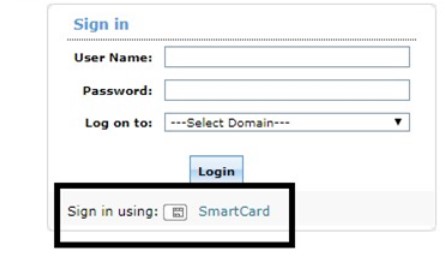
Smart card authentication
This article gives you the step-by-step instructions to enable smart card authentication in ADSelfService Plus.
Prerequisites:
- SSL must be enabled for configuring smart card authentication. To enable SSL, navigate to Admin > Product Settings > Connection. Select the Enable SSL Port [HTTPS] checkbox, and specify the port number. Click Save.
- Obtain the CA Root Certificate from the Certificate Authority. You will need this file while configuring the smart card authenticator. So, save this file and keep it safe.aTo download the certificate file from the Certificate Authority’s website, visit http://<CertificateAuthorityServerName>/certsrv/.Note: Replace ‘CertificateAuthorityServerName’ in the URL with the name of your certificate server.
Configuration steps:
- Log into the ADSelfService Plus web console with admin credentials.
- Navigate to Admin > Customize > Logon Settings.
- Click the Smart Card Authentication tab.
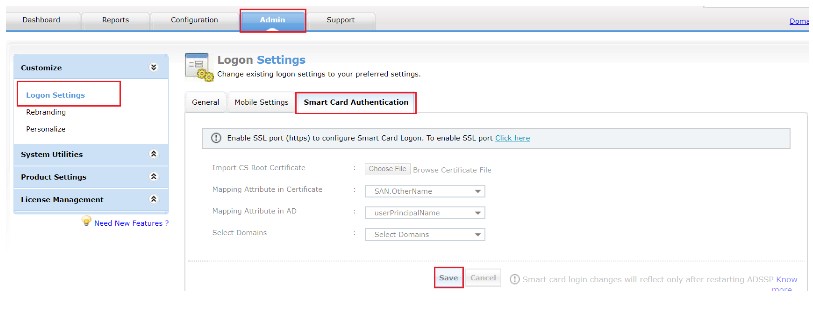
Connection Configurations
- In the Import CA Root Certification field, click Browse to import the required Certification Authority root certification file (X.509 certificate). Refer step 2 of prerequisites.
- In the Mapping Attribute in Certificate field, select a unique attribute in the certificate for mapping.
- Ensure that a unique attribute from the certificate is mapped to a unique attribute in Active Directory. Both attributes must have the same values.
- ADSelfService Plus provides the ability to select any attribute of the smart card certificate that uniquely identifies a user. You can choose any attribute among SAN.OtherName, SAN.RFC822Name, SAN.DirName, SAN.DNSName, SAN.URI, email, distinguishedName and CommonName. In case other attributes are used to uniquely identify the user in your environment, enter the attribute name in the text box provided and click the '+' icon.
- In the Mapping Attribute in AD field, specify the LDAP attribute that should be matched with the specified certificate attribute.
- Here you need to specify the particular LDAP attribute that uniquely identifies the user in Active Directory.E.g., sAMAccountName.
- During authentication, ADSelfService Plus reads the value corresponding to the certificate attribute that you specified in the certificate's mapping attribute and compares it with the specified mapping attribute in AD.
- In the Select Domains field, select the domains for which you wish to enable smart card authentication from the drop down menu.
- Click Save.
- Restart ADSelfService Plus for the changes to take effect.
That's it! Users can now use their smart cards to log into ADSelfService Plus!
Like this tip? Get the most out of ADSelfService Plus by checking out more tips and tricks here.
Sticky Posts
Did you know - How to configure Office 365 as SMTP Mail Server
ADSelfService Plus allows you to use Office 365 as an SMTP mail server to send notifications, OTP etc. to your users. To make it happen, all that you need is just an Office 365 account with a mailbox associated with it. Steps to configure ADSelfService Plus to use Office 365 as your mail server: Login to ADSelfService Plus with the administrator credentials. Navigate to Admin -> Product Settings -> Server Settings. In the Server Settings page, click the Mail Settings tab. Enter smtp.office365.comDid You Know - Real-Time Password Sync Agent
The real-time password sync agent in ADSelfService Plus accomplishes the following objectives: Sync password changes in Active Directory with connected IT systems and applications in real-time. Send email and SMS notifications to end users immediately after a native password modification, which includes password change by users through the Ctrl+Alt+Del option and password reset by the admins through the ADUC console. [Planned Feature] Password Policy Enforcer - Enforce custom password policies[Tips & Tricks] How to enable smart card authentication in ADSelfService Plus?
How about a hassle-free, passwordless, yet secure login to ADSelfService Plus? ADSelfService Plus supports smart card authentication which enables users to access the self-service portal securely, without having to enter a password. If your organisation already utilises smart cards/PKI/certificates as an authentication system, the sensible choice would be for you to use the smart card authentication option in ADSelfService Plus to verify users' identities. This option enables ADSelfService Plus[Tips and Tricks] – How to force users to choose their manager from specific OUs or groups during self-update?
When users are using the self-directory update feature in ADSelfService Plus to update their manager information, they can make use of a search option which will show users from all OUs and groups in the domain. With too many results being displayed, there is a good chance that the user picks the wrong user as the manager, which could then lead to requests and confidential items being sent to the wrong person. ADSelfService Plus provides an option with which you can specify the OUs and groups from[Tips and Tricks] – How to synchronize passwords between two Active Directory domains?
One of the most common issues in dealing with multiple Active Directory domains is handling different sets of passwords. Be it for domain migrations or maintaining separate domains for desktop login and Exchange mail box access, users have to handle different passwords for each domain. This would complicate user password management and result in an increase in the number of password-related tickets, eventually affecting overall productivity. This article will show how you can synchronize passwords